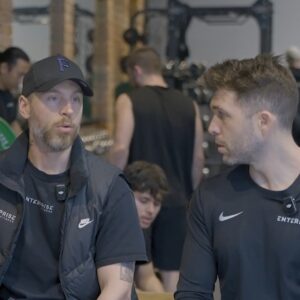
I sat across from my mate Luke the other day. We were training arms — close-grip bench, reverse curls, supported bicep curls — and in between sets, he told me his story. The full thing. Not the highlights reel. Not the cleaned-up version you tell at a dinner party. The real thing.
And I’m going to share it with you. Not because it’s easy to hear, but because you need to hear it.
Because somewhere in Luke’s story is your story. Or your brother’s. Or your client’s. Or your kid’s. And if you walk away from this thinking you’re a victim of your circumstances, you missed the entire point.
The Slow Slide
Here’s what people get wrong about addiction. They think it’s a light switch. One day you’re fine, the next you’re on the floor. That’s not how it works. Not even close.
Luke was a kid who loved nature. Wanted to be a herpetologist — that’s the study of reptiles and amphibians. He was introverted, passionate about wildlife, running through national parks in Warrandyte with his dogs. The kind of kid you’d look at and think, yeah, he’s going to be alright.
Then he turned eighteen, got out of school, went to La Trobe University. Found people who were culturally more like him — his dad’s Serbian, his mum was Dutch, and he’d grown up in a very Australian school where he always felt slightly on the outside. At uni, surrounded by people who felt like family for the first time, he started going out. The clubs, the nightlife, the women. And then the drugs.
It didn’t start with a catastrophic decision. It started with a good time. And that’s the thing Luke said that stuck with me: “The moment you kind of realise you have a problem is the moment you really do have a problem. The moment you realise you had a problem, you really had the problem five years before that moment.”
Read that again. Because that’s not just true for drugs. That’s true for your diet. Your training. Your relationships. Your business. The moment you see the problem clearly, it’s already been rotting in the walls for years.
Luke went from going out to promoting clubs. From promoting clubs to hosting nights at the biggest venues in Melbourne. From hosting to networking with people on the wrong side of the law. Drinking, drugging, selling. A slow, steady slide that felt, in the moment, like he was just living his life.
And that’s the trap. It always feels like you’re just living your life.
The Wreckage Before Rock Bottom
Before we get to rock bottom — and we will — you need to understand what was happening underneath. Because Luke’s story didn’t start at eighteen. It started much earlier.
His grandmother killed herself. His aunt killed herself. His karate sensei — the man his mother connected him to as a young boy — hanged himself. Luke was surrounded by suicide before he was old enough to drive a car.
His mother was an alcoholic. When she was sober, she was incredible — connecting him to nature, animals, karate, laying down the values that would eventually save his life. But when she drank, she became someone else entirely. Luke had to watch out for his own mother. He stopped her from swallowing a handful of pills once. As a child.
Think about that for a second. A kid whose job it is to keep his mother alive.
He told me something that hit hard: “I actually felt as a child that anyone that I loved was like a curse on them. They could die.”
That’s the belief system he was carrying into adulthood. That’s the invisible weight on the bar that nobody else could see. And when you’re carrying that kind of load internally, it doesn’t take much external pressure to break you.
The First Wake-Up Call That Wasn’t Enough
In 2013, Luke was driving down the road and blacked out. He had his dog in the back. He hit one of those yellow traffic barriers, flipped his Jeep Wrangler twice. His dog got thrown from the car. Luke got pinned under the steering wheel.
He told me that in that moment, pinned under the wheel, knowing the police were coming, he had a choice — panic or breathe. He chose to breathe. Focused on his breath. Got himself calm enough to get out.
His dog was fine. Luke went to rehab for the first time.
But here’s what’s important: that first rehab wasn’t the turning point. He went in thinking he’d take a break, manage his use, get back to some kind of normal. He didn’t go in with the intention of transforming his life. He went in to catch his breath.
And that’s exactly what happens when you’re not truly ready. You mistake a rest stop for a destination. You recover just enough to go back to the same habits that put you in the ditch. Which is exactly what Luke did.
Psychosis
Between the first and second rehab, things got darker. Luke experienced a drug-induced psychosis — though he believes sleep deprivation played a massive role — and ended up locked in the psychiatric ward at Austin Hospital for thirteen days.
Thirteen days. In a psychiatric ward. Hearing things, seeing things, unable to distinguish what was real and what wasn’t.
He told me something interesting about that experience. He said he’s not entirely sure everything he experienced was a delusion. His view is that maybe, in that fractured state, he was picking up frequencies that we normally can’t access. Whether you agree with that or not isn’t the point. The point is that even in describing the most terrifying experience of his life, Luke isn’t playing the victim. He’s looking for meaning.
It took him three to four months after being released to slowly reconnect with reality. Three to four months of living at his dad’s house, trying to figure out what was real.
And even that wasn’t enough to stop him.
The Real Rock Bottom
The spiral continued. Wrong people, wrong choices, isolating himself from family and friends. His mother — who had been sober for fifteen years at this point — eventually cut him off. Told him she couldn’t do it anymore. He was on his own.
That was one of the best things she ever did for him.
Eventually, Luke went to his mum and said he’d had enough. He was ready. She told him if he was one hundred percent serious, to come to her house and they’d start the process. So he did. He started detoxing at her home.
The first night, he got paranoid. Couldn’t sleep. Started tipping towards another psychosis. Something was going wrong physiologically. He got up, walked to his brother’s room, collapsed against the door, hit the floor, and went into a seizure. Foaming at the mouth. Woke up twelve minutes later to paramedics resuscitating him, looking up at his mum and brother staring down at him.
Here’s what he didn’t know at the time: he’d been on benzodiazepines daily. If you come off benzos cold turkey — same as alcohol — it can kill you. Your body has developed a chemical dependence. You cut it off without tapering, and your nervous system can shut down. That seizure was his body screaming.
That was his rock bottom.
The Work
Now, here’s the part that most people skip over in stories like this. They love the dramatic rock bottom. They love the redemption arc. But they gloss over the actual work because the work isn’t cinematic. It’s brutal.
Luke checked into Melbourne Clinic in June 2016. A private rehab that was almost entirely substance-free — they only used medication when absolutely necessary for safe detox. No cushioning. No numbing.
For thirty days, Luke was in a military-style schedule. Up at six-thirty. Breakfast for half an hour. Then straight into programs — one-on-one sessions with psychologists, group counselling with ex-drug and alcohol counsellors, AA meetings, NA meetings. All day, every day, until five. Then dinner. Then optional meetings at seven-thirty.
I asked him what was brutal about it. His answer wasn’t withdrawal. It wasn’t the physical symptoms. It was delving into his past traumas. Dealing with his inner child. Peeling back every layer of the onion, daily, with nowhere to hide.
That’s the work nobody wants to do. Because it’s not sexy. It’s not Instagram-worthy. It’s sitting in a room and facing every single thing you’ve been running from. And doing it again the next day. And the day after that.
I asked Luke a question during our session: would rock bottom alone have been enough? His answer was immediate: “No. You need the work. Rock bottom would have been a rock bottom. But without the work, I would have ended up back at another rock bottom. Or death.”
And this is where I’ll be direct with you. Because this applies to everything. Not just drug addiction. Your fitness plateau. Your failing business. Your broken relationship. Rock bottom is not the cure. Rock bottom is the alarm clock. If you hear the alarm and roll over and go back to sleep, you’ll just hit another bottom. And another. And the definition of hell is a bottomless pit — things can always get worse.
The alarm wakes you up. The work changes your life.
June 13, 2016 was Luke’s sobriety date. He hasn’t touched a drug or a drink since. Coming up on ten years.
Then Life Tested Him Again
You’d think the universe would give a bloke a break after all that. It didn’t.
Luke’s mum was diagnosed with multiple myeloma — a cancer in the blood considered incurable. She didn’t know how long she had left.
But here’s what Luke said that stopped me mid-set: the diagnosis was, in a strange way, a blessing. Because it forced the family — Luke, his brother Adam, and their mum — to have the conversations nobody wants to have. About life. About death. About everything in between. Luke had already been sober for four years at that point, and the diagnosis brought them closer than they’d ever been.
There’s a story — Luke called it Russian, I corrected him, it’s the Chinese farmer parable — that captures this perfectly. A farmer’s horse runs away. The neighbours say how terrible. The farmer says: could be good, could be bad. The horse comes back with five stallions. How wonderful! Could be good, could be bad. The son breaks his leg trying to break in the stallions. How awful! Could be good, could be bad. The military comes to conscript young men, but the son’s leg is broken so he can’t go. How lucky!
You never know the outcome of an event while you’re in it. Some of the worst things that happen to you produce the most extraordinary results two years down the track. And some of the best things that happen to you lead to the worst outcomes. You can only connect the dots looking backwards.
Luke and his family got to connect deeply because of the cancer diagnosis. They had the uncomfortable conversations. They rebuilt the relationship on a foundation of honesty that only comes when you’re staring down mortality.
Then in 2020, someone experiencing a psychotic episode broke into Luke’s mother’s home and killed her.
I’ll let that sit with you for a moment.
The woman who gave Luke his values. Who connected him to nature, to karate, to animals. Who cut him off when he needed it most. Who held him while he detoxed. She was murdered. By someone going through the very same kind of psychosis that Luke himself had experienced.
Victim Or Victor — You Choose
Here’s where most people’s story would end. Or worse, here’s where most people would set up camp in the victim tent and never leave. And honestly, nobody would blame them.
But Luke said something that I think everyone needs to hear: “You can choose to be a victim, or you can choose to utilise those experiences and learn to be like a superpower.”
That’s not a motivational poster. That’s a man who buried his murdered mother saying those words while curling dumbbells.
Luke and his brother Adam started a company called Maudcare — named after their mum. It’s a disability support company helping people with physical disabilities and psychosocial issues, including people battling drug and alcohol addiction. They’ve grown to over fifty employees in just over two years. Zero marketing spend. Pure word of mouth. Because the service is that good. Because their hearts are in it. Because they’ve lived it.
Think about the poetry in that. A man whose mother was killed by someone in psychosis now dedicates his life to helping people with mental health issues. A man who went through multiple rehabs now helps others find their way. He didn’t become bitter. He became useful.
Empathy, Not Sympathy
This brings me to something I teach every trainer, every coach, everyone who works with people in any capacity. And Luke’s story is the perfect illustration.
There are two forces in coaching: empathy and authority. You need both. Here’s how I explain it.
Imagine a helicopter. You’re the coach. You’re in the helicopter. Your client is in the burning boat below. They’re surrounded by water, fire, chaos. All they can see is the problem. You can see the whole picture from above.
Your job is to lower the rope ladder and say: “I see your situation. It’s real. It’s hard. Now put your hand on the rope. Let me guide you to safety.”
That’s empathy with authority.
The moment you become sympathetic — the moment you say “I feel what you’re feeling, let me get in the boat with you” — you’re both drowning. You’re both on fire. You can’t help anyone from inside the burning boat.
This is what society gets wrong right now. We’ve confused sympathy with compassion. We reward people for staying in the boat. We celebrate victimhood. We give likes and follows and attention to people who tell their trauma story on repeat without ever picking up the rope ladder.
Luke made a point about this that’s worth paying attention to. He said he’s mindful not to build his identity around being a recovering addict. He doesn’t lead with “I’m ten years sober” as if that’s who he is. Because the moment your identity is anchored to your trauma, you’ve put yourself in a prison. You’ve stopped growing. You’ve traded one addiction for another — this time, the addiction is to the story you tell about yourself.
We’re meaning-making creatures. We attach significance to everything — the brand on your shirt, the car you drive, the label you give yourself. And we do it because it’s uncomfortable to exist without a box to put ourselves in. But those boxes have walls. And walls keep you contained.
Everyone Is Powerful Beyond Measure
Luke said something towards the end of our session that I want to leave you with.
“Everyone is powerful beyond measure. People are amazing. Human beings are incredible.”
He’s not saying that from a meditation retreat in Bali. He’s saying that as a man who has experienced psychosis, multiple rehabs, family suicide, addiction, and the murder of his mother. He’s saying it because he’s living proof.
The biggest fear Luke ever had was losing his mum. It gave him anxiety just thinking about it. And then it happened — in the most horrific way imaginable. And he’s still here. Still building. Still training. Still showing up.
You don’t know what you’re capable of until life forces you to find out. And the truth is, you’re capable of far more than you think. But capability without action is just potential sitting in a drawer. You have to do the work. You have to face the uncomfortable things. You have to stop telling yourself the story of why you can’t and start doing the things that prove you can.
You can’t change anyone who isn’t ready to change. Luke himself said that if his future self had visited him during his darkest days and given him the most inspiring speech in the world, the younger version would have gone and done more drugs. People change when they’re ready. When they’ve hit their own version of rock bottom. When the pain of staying the same finally exceeds the pain of changing.
But here’s the thing — you can build resilience before you’re forced to. You don’t have to wait for the seizure, the psychosis, the phone call that changes everything. You build resilience the same way you build muscle: by exposing yourself to challenges you can overcome. Not by hiding from discomfort. Not by sheltering yourself or your kids from every hard thing. But by climbing the tree, knowing you might fall, and learning that a fall isn’t the end of the world.
Smooth seas have never made for a skilled mariner.
And the bottom? The bottom is not the end. It’s just where the real work begins.
Luke’s company Maudcare supports people with disabilities across Melbourne. If you or someone you know needs support, look them up. And if you’re facing your own version of rock bottom right now — whether it’s addiction, mental health, or just a life that’s gone sideways — know this: you are powerful beyond measure. But nobody can climb the rope ladder for you. You have to reach up and grab it yourself.